5s
+1
Submission successful!
Zhengzhou Gofine Machine Equipment CO., LTD lily@zzgofine.com +86-19536984226

Product Details
Place of Origin: China
Brand Name: Gofine
Certification: CE
Model Number: H1
Payment & Shipping Terms
Minimum Order Quantity: 1 set
Price: $4500-8900
Packaging Details: plywood case
Delivery Time: 1-3 Sets/15days
Payment Terms: L/C,T/T,Western Union
Supply Ability: 25 Sets/Month
Turning Pile Width: |
≤ 3.5 Meters |
Turning Pile Height: |
≤ 1.6 Meters |
Pile Row Spacing: |
0.8-1 Meter |
Horsepower: |
238 Hp |
Spindle Speed: |
2400 R/min |
Travel Speed: |
5-10 M/min |
Turning Efficiency: |
1500-2000 Cubic Meters/hour |
External Dimensions: |
5mx2.8mx3.25m |
Raw Materials: |
Biological Waste, Poultry Manure, Sludge, Food Waste |
Application: |
Organic Fertilizer Production |
Work Process: |
Composting Mixing |
Product Overview
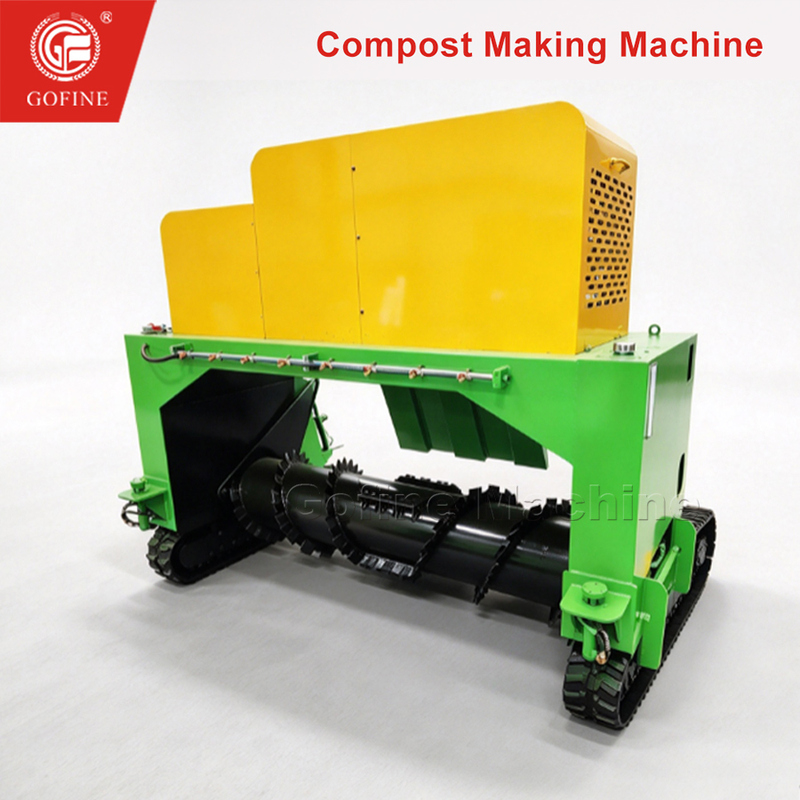
Processing diverse municipal solid waste, food scraps, green waste, and agricultural residues requires versatile composting machinery capable of handling fluctuating moisture levels, variable material densities, and harsh site environments. The Remote Controlled Crawler Composter Fertilizer Equipment for Organic Waste is a heavy-duty, self-propelled windrow processing system engineered specifically for high-efficiency aerobic degradation of mixed organic bio-waste.
Driven by an advanced wireless remote control unit, operators can safely navigate the composter across the site from a comfortable line-of-sight distance, eliminating direct exposure to dust, offensive odors, and bio-hazardous emissions. Its rugged crawler track undercarriage delivers high ground clearance, zero-radius pivot turning, and exceptional traction over unpaved soil, concrete pads, and uneven outdoor yards. The high-torque mixing rotor aggressively lifts, shreds, and aerates compacted organic waste windrows, replenishing oxygen levels and homogenizing moisture to accelerate microbial breakdown. Manufactured by Gofine Machine with high-strength structural steel and industrial-grade hydraulic drives, this remote-controlled composter turns raw organic waste into high-quality bio-fertilizer efficiently and safely.
Technical Comparison: Remote Control vs. Drivable Crawler Compost Turner
When upgrading an organic waste composting machine line, selecting the correct operator platform impacts both operational expenses and workplace safety. Below is a direct comparison between our remote-controlled windrow compost turner and traditional human-driven models:
| Key Performance Metric | Remote Control Crawler Compost Turner | Traditional Drivable Crawler Compost Turner |
| Operator Health & Safety | Maximum Protection: The operator remains 100–200m away, eliminating exposure to hazardous ammonia, hydrogen sulfide, and toxic airborne dust. | High Exposure Risk: The operator sits directly above the off-gassing compost pile inside a cab, requiring heavy air filtration maintenance. |
| Working Height & Terrain Access | Compact & Highly Maneuverable: Operates seamlessly under low ceilings, inside enclosed greenhouses, or across steep, unstable indoor bays. | Height-Restricted: Requires high overhead clearance to accommodate the operator cabin and rollover protection structures. |
| Operational Labor Costs | Single-Person / Fleet Operation: One worker can safely manage multiple remote units or monitor auxiliary loading machinery simultaneously. | Dedicated Driver Needed: Requires a skilled driver per machine for full shifts under uncomfortable working conditions. |
| Equipment Center of Gravity | Ultra-Low Center of Gravity: Removing the heavy driver cab lowers the machine's profile, making it virtually un-tippable on uneven piles. | Higher Profile: Higher center of gravity increases rollover risks when traversing deep, uneven, high-moisture organic material heaps. |
Engineering Features & Technological Advantages
High-Intent Industrial Applications
This versatile organic fertilizer compost machine excels in processing high-moisture, highly fibrous waste streams across several sector categories:
Organic Fertilizer Production Line Processing Technology
The manufacturing process of high-grade bio-organic fertilizer relies on a synchronized balance between biological fermentation and mechanical refinement. Below is the detailed process flow engineered for maximum nutrient retention and optimal granule forming:
Frequently Asked Questions
Q1: How does the remote control system improve safety compared to traditional drivable turners?
A: In high-intensity composting, fermenting waste releases high concentrations of toxic gases (ammonia, hydrogen sulfide, carbon monoxide) alongside heavy airborne spores and dust. Wireless remote control allows operators to direct the machine from up to 200 meters away in a clean, safe environment, eliminating respiratory hazards and driver fatigue.
Q2: What pile dimensions can the remote control crawler compost turner process?
A: Depending on the model frame and rotor diameter, our crawler compost turners typically process windrow heights ranging from 1.0 to 2.2 meters and windrow widths from 2.5 to 5.0 meters. The hydraulic rotor elevation system allows operators to adjust working depth in real time to suit different pile densities.
Q3: What moisture content range is ideal for machine operation?
A: The machine performs best with raw material moisture levels between 40% and 65%. For sticky or saturated livestock dung (moisture over 70%), we recommend blending in dry agricultural residues like wheat straw, biochar, or sawdust prior to the first turning cycle.
Q4: How often should the compost windrow be turned during fermentation?
A: During the initial 3 to 7 days of active heating, turning the pile once every 1 to 2 days maintains high oxygen levels and vents excess heat. As the pile stabilizes (days 8–14), turning frequency can be reduced to once every 3 to 4 days until fermentation is fully complete.
Q5: What is the average lifespan of the turning blades, and are replacement parts available?
A: Our heavy-duty flail blades are forged from high-wear alloy steel and treated with a vacuum thermal hardening process. Under standard organic waste conditions, a set of blades typically lasts for 1,500 to 2,500 hours of active turning. We stock all consumable parts and offer factory-direct replacement kits for rapid dispatch.
video
video
video
video
video
video