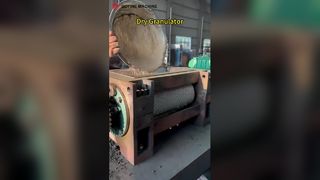
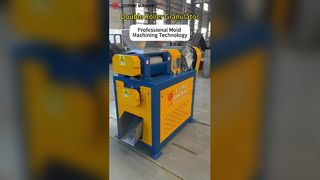
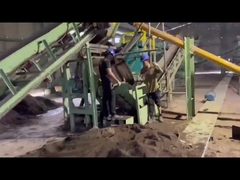
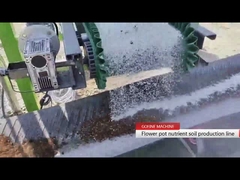
Brief: Let’s dive in — see this solution in action and notice the key moments. This video provides a detailed walkthrough of the Double Roller Extrusion Granulator, showcasing how it transforms fine powders into dense, uniform granules using a dry granulation process. You'll observe the high-pressure roller compaction in action, the continuous automated operation, and the final granule output, highlighting its efficiency for fertilizer production and other industrial applications.
Related Product Features:
Utilizes a dry granulation process that produces granules without adding moisture or liquid binders.
Features high-pressure roller compaction with robust rollers and a powerful hydraulic or spring-pressure system.
Achieves excellent material densification, increasing bulk density for improved storage and transport.
Designed for continuous and automated operation, enabling seamless integration into production lines.
Offers versatility by processing various materials like fertilizers, chemicals, and minerals with customizable granule size and shape.
Environmentally friendly with a closed system that minimizes dust pollution and avoids wastewater generation.
Built with low maintenance and robust construction using high-wear-resistant materials for long service life.
Suitable for extensive applications in fertilizer, chemical, mineral, pharmaceutical, and food industries.
FAQs:
What is the principle behind the Double Roller Extrusion Granulator?
The granulator operates on the principle of roll press compaction, where two synchronized, counter-rotating rollers apply extreme mechanical pressure to raw powder material, forcing it through precisely designed molds to form a dense sheet that is then broken into uniform granules.
Can this machine handle materials other than fertilizers?
Yes, the Double Roller Extrusion Granulator is highly versatile and can process a wide range of materials including chemicals like pigments and resins, minerals such as metal powders and ores, and even powders in the pharmaceutical and food industries.
Does the dry granulation process require any additional drying steps?
No, the dry granulation process produces granules without adding moisture or liquid binders, which eliminates the need for subsequent drying steps, making the process more efficient and economical.
How is the granule size and shape controlled?
Granule size and shape are controlled through the precisely designed molds on the roll surfaces and the subsequent crushing and screening process. The equipment allows for customization to meet specific product requirements.