5s
+1
Submission successful!
Zhengzhou Gofine Machine Equipment CO., LTD lisa@zzgofine.com +86-13285072539

Product Details
Place of Origin: China
Brand Name: Gofine
Certification: CE
Model Number: GF10
Payment & Shipping Terms
Minimum Order Quantity: 1 set
Price: $5688~6888
Packaging Details: plywood case
Delivery Time: 1-3 Sets/15days
Payment Terms: L/C,T/T,Western Union,
Supply Ability: 25 Sets/Month
Features: |
High Efficiency, Easy Operation, Low Noise |
Usage: |
Agriculture, Fertilizer Production |
Condition: |
New |
Material: |
Stainless Steel/Carbon Steel |
Capacity: |
1-3 T/h |
Powder Size: |
80-320 Mesh |
Output: |
3-5t/h |
Energy: |
Electricity / Diesel |
Main Engine Speed: |
3000r/min |
Function: |
Material Crusher |
Features: |
High Efficiency, Easy Operation, Low Noise |
Usage: |
Agriculture, Fertilizer Production |
Condition: |
New |
Material: |
Stainless Steel/Carbon Steel |
Capacity: |
1-3 T/h |
Powder Size: |
80-320 Mesh |
Output: |
3-5t/h |
Energy: |
Electricity / Diesel |
Main Engine Speed: |
3000r/min |
Function: |
Material Crusher |
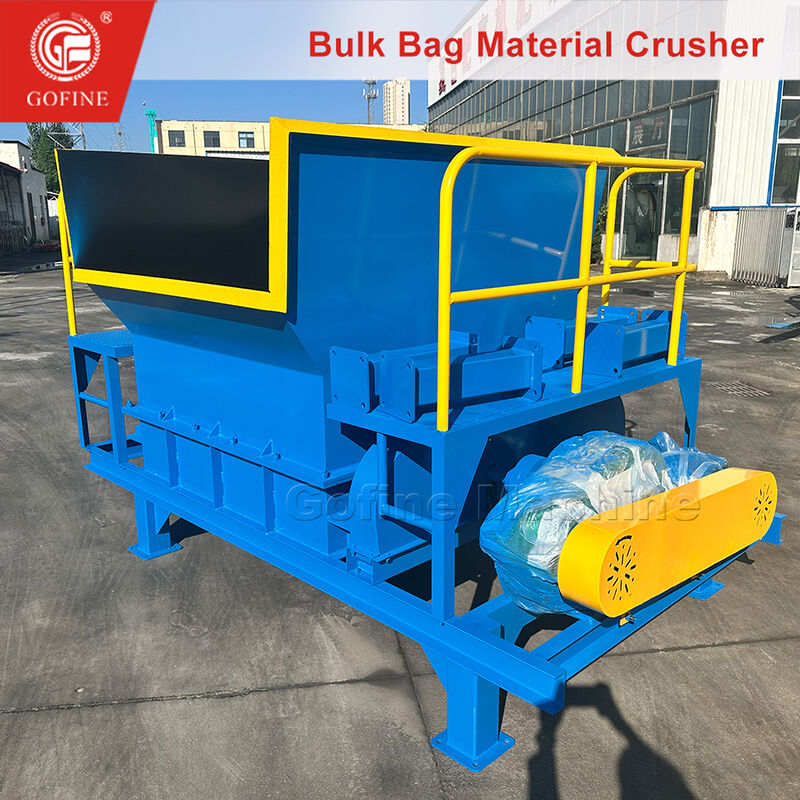
The Bio-Organic Fertilizer Lump Breaker for Ton Bag Line is a rugged, heavy-duty material conditioning unit specifically engineered for inline integration within bulk bag (FIBC) discharging and batching systems. It addresses a major operational challenge in biological fertilizer handling: bio-organic formulations containing functional microbes, amino acids, and humid substances frequently absorb atmospheric moisture and consolidate under heavy stacking pressure, transforming into rock-hard mass blocks inside ton bags.
Designed with a wide-throat intake that matches standard ton bag hopper footprints, the machine utilizes synchronized, high-torque dual shafts equipped with heavy-forged breaking elements. As the compacted bio-organic masses drop from the bag spout, these teeth deliver intense mechanical shearing and splitting forces, fracturing the dense blocks instantly. Featuring an un-obstructed, screenless straight-through gravity discharge path, the equipment runs at a optimized low RPM to process high volumetric flows without generating localized friction heat, thereby safeguarding temperature-sensitive microbial cultures. This rapid reduction ensures the material is returned to a manageable, free-flowing state, completely eliminating hopper bridging and safeguarding downstream dosing systems from overloading.
video
video
video
video
video
video
video
video
video
video
video